One peaceful day on Earth, two remnants of Frieza’s army named Sorbet and Tagoma arrive searching for the Dragon Balls with the aim of reviving Frieza. They succeed, and Frieza subsequently seeks revenge on the Saiyans.
The Z-Fighters must contend with Lord Beerus, the God of Destruction, but only a God can fight a God, and none of them are Gods. However with the creation of the Super Saiyan God, will the Z-Fighters be able to defeat Lord Beerus?
After learning that he is from another planet, a warrior named Goku and his friends are prompted to defend it from an onslaught of extraterrestrial enemies.
Stars:
Doc Harris,
Christopher Sabat,
Scott McNeil
Vegeta is lured to the planet New Vegeta by a group of Saiyan survivors in hopes that he will be the king of their new planet. But when he finds that they have ulterior motives of universal… See full summary »
The adventures of Earth’s martial arts defender Son Goku continue with a new family and the revelation of his alien origin. Now Goku and his allies must defend the planet from an onslaught of new extraterrestrial enemies.
Son Gokû, a fighter with a monkey tail, goes on a quest with an assortment of odd characters in search of the Dragon Balls, a set of crystals that can give its bearer anything they desire.
A mysterious being named Hoy arrives on Earth and asks the Z Warriors to use the dragon balls to help him release Tapion. Tapion, an ancient warrior imprisoned in a music box, and Hoy needs… See full summary »
After destroying Frieza on Namek, Goku returns to a peaceful life on Earth. When informed his brother has been killed by a Saiyan, Cooler is hell bent on killing Goku, and making him pay … See full summary »
As convenience goes, wireless charging can’t be beat. You simply drop your phone onto the charger and walk away. Gone is the headache of managing cables that inevitably break or get lost.
Until recently, the main drawback to wireless chargers has been slow adoption and slow charging. This style of charging is still not ubiquitous, but you can now find Samsung, LG, Sony, and Moto phones that support it on the Android side, and Apple has adopted it for its iPhone lineup as well. And the technology itself is finally reaching a point where its speed is easier to live with, too.
Now that it’s a good time to go out and grab a stand or pad, we’ve tested some of the most popular models out there for both Android and iPhone, and discovered our favorites among the bunch. Read on for our findings, and check back periodically for our latest updates.
Upadated 1/24/19 to include our review of the iOttie iON Wireless Stand, which has a stylish look that makes it suitable for any environment, and speedy performance, especially on iPhones. Scroll to the bottom of this article to see all of our charger reviews.
The best wireless charger
Anker’s PowerWave 7.5 Stand is our current top pick. It charges faster than any other pad we tested, looks nice, and has a stand that makes checking notifications very easy. A cooling fan in the base can be loud in a quiet environment, but it’s not a deal breaker—just something to keep in mind.
What to look for in a wireless charger
Until recently, there were two different wireless charging standards that you had to be aware of when purchasing a wireless charging pad: the Power Matters Alliance (PMA) standard, and the Wireless Power Consortium’s Qi standard.
Powermat has since agreed to join the WPC and embrace the Qi standard. (We’ve noted in our individual wireless charger reviews if it supports the PMA standard, in case you have an older Android device that only supports PMA.) Now you only have one factor to consider when choosing a wireless charging pad: Does it support fast charging?
As technology has evolved, so too has the speed at which a phone can wirelessly charge. You will need to check the speed at which your phone can wirelessly charge, which is usually given in terms of 7.5 watts (W), 9W, or even 15W.
Sometimes software plays a part in the speed. For example, an iPhone 8, 8 Plus, or X running iOS 11.2 or later charges at 7.5W, while any of the same iPhones running iOS 11.1 charges at 5W.
The packaging for most wireless chargers will indicate its speed. Look for the wattage speed on the box or in the specification listing for a charger, then compare that with the speed at which your phone can charge.
Do keep in mind that as fast as wireless chargers have become, the included charger for most phones will be your best bet when you’re in a hurry and need as fast a charge as possible.
How we tested
Android
In order to properly test and measure how long a wireless charger takes to charge a smartphone from 0 to 100 percent, we followed the steps below each time we placed a phone on the charging pad. For the initial round of tests, we used an unlocked Samsung Galaxy S9.
We enabled airplane mode on the Galaxy S9 to prevent notifications or connections from impacting battery life throughout each test.
To completely drain the battery on the Galaxy S9, we looped a movie in VLC with screen brightness set to 100 percent until the phone powered off.
If a wireless charger included its own power supply, we used it. If not, we used Samsung’s standard wall adapter and an appropriate cable.
The phone was placed on a wireless charging pad, and a timer was set for four minutes (the minimum time required to bring the phone back to life across all the pads we tested). After four minutes, the phone was powered on and unlocked.
A time-lapse video was recorded of each charging session using a Wyze Cam, with a photo captured every 60 seconds.
Charge time was calculated by looking at the video and noting the time when the always-on-display of the Galaxy S9 would register 100%.
We repeated the test three times for each wireless charger, then averaged the results.
iPhone
Testing a wireless charging pad with an iPhone requires a different procedure than with an Android handset. The iPhone doesn’t have an always-on display feature that constantly shows the current battery percentage. Because of this we opted to charge our iPhone X for a period of 60 minutes and measure the achieved charged level following the steps below:
We enabled airplane mode on the iPhone X in order to prevent any unnecessary notifications or connections from impacting battery life throughout the test.
Using VLC and a display brightness set to 100%, we completely drained the battery until the iPhone X powered off.
If a wireless charger included its own power supply, we used it. If not, we used Samsung’s standard wall adapter and appropriate cable.
The phone was then placed on a wireless charging pad, and a timer was set for 7 minutes (the minimum time required to bring the phone back to life across all the pads we tested).
At the 7 minute mark, the iPhone would be unlocked and then placed back on the charging pad. A new timer was set for 60 minutes.
After the 60 minute timer expired, the phone was removed from the pad and the battery percentage was recorded.
We repeated this process three times for each charging pad and averaged the results.
For an approximate ballpark of how long it’ll take to reach full charge with an iPhone, you can divide 60 (the number of minutes used for this test) by the percentage result listed in each review. So if the result is an average charge of 36 percent in 60 minutes, the soonest that a full charge will take is roughly 167 minutes, or 2 hours and 47 minutes.
Keep in mind that this is an imprecise estimate: We say “approximate” because it’s possible for charging to slow down during a full charge.
All of our wireless charger reviews
Curious about the other options out there? Below is a list of all the wireless chargers we’ve reviewed. We’ll keep evaluating new ones on a regular basis, so be sure to come back to see what else we’ve tested.
Editor’s note, 9/17/2018: The original version of this article incorrectly stated that Powermat owns the PMA standard. We regret the error.
The Avengers and their allies must be willing to sacrifice all in an attempt to defeat the powerful Thanos before his blitz of devastation and ruin puts an end to the universe.
Directors:
Anthony Russo,
Joe Russo
Stars:
Robert Downey Jr.,
Chris Hemsworth,
Mark Ruffalo
On the run in the year of 1987, Bumblebee finds refuge in a junkyard in a small Californian beach town. Charlie, on the cusp of turning 18 and trying to find her place in the world, discovers Bumblebee, battle-scarred and broken.
Director:
Travis Knight
Stars:
Hailee Steinfeld,
Jorge Lendeborg Jr.,
John Cena
T’Challa, heir to the hidden but advanced kingdom of Wakanda, must step forward to lead his people into a new future and must confront a challenger from his country’s past.
Director:
Ryan Coogler
Stars:
Chadwick Boseman,
Michael B. Jordan,
Lupita Nyong’o
Fueled by his restored faith in humanity and inspired by Superman’s selfless act, Bruce Wayne enlists the help of his newfound ally, Diana Prince, to face an even greater enemy.
Thor is imprisoned on the planet Sakaar, and must race against time to return to Asgard and stop Ragnarök, the destruction of his world, at the hands of the powerful and ruthless villain Hela.
Director:
Taika Waititi
Stars:
Chris Hemsworth,
Tom Hiddleston,
Cate Blanchett
When a pilot crashes and tells of conflict in the outside world, Diana, an Amazonian warrior in training, leaves home to fight a war, discovering her full powers and true destiny.
Foul-mouthed mutant mercenary Wade Wilson (AKA. Deadpool), brings together a team of fellow mutant rogues to protect a young boy with supernatural abilities from the brutal, time-traveling cyborg, Cable.
Director:
David Leitch
Stars:
Ryan Reynolds,
Josh Brolin,
Morena Baccarin
As Scott Lang balances being both a Super Hero and a father, Hope van Dyne and Dr. Hank Pym present an urgent new mission that finds the Ant-Man fighting alongside The Wasp to uncover secrets from their past.
Fearing that the actions of Superman are left unchecked, Batman takes on the Man of Steel, while the world wrestles with what kind of a hero it really needs.
Peter Parker balances his life as an ordinary high school student in Queens with his superhero alter-ego Spider-Man, and finds himself on the trail of a new menace prowling the skies of New York City.
Director:
Jon Watts
Stars:
Tom Holland,
Michael Keaton,
Robert Downey Jr.
Arthur Curry, half human half from Atlantis, goes on a trip of a lifetime. Not only does this adventure compel him to come to terms with his real identity, but it also forces him to discover whether he is entirely worthy of fulfilling his own destiny: becoming a king. Written by Domingo Alvarez
As Arthur and Mera are sailing away from Sicily, much of their dialogue shows them at the stern of the boat, with the boat’s wake and the setting sun behind them. The final shot of the sequence, from behind the boat, shows it sailing forward towards the setting sun. The sun (or the boat) has changed location by 180 degrees. See more »
Safari Song
Written by Daniel Wager, Joshua Kiszka, Samuel Kiszka and Jacob Kiszka
Performed by Greta Van Fleet
Courtesy of Lava Music / Republic Records
Under license from Universal Music Enterprises See more »
Arlo Technologies has some good news for system owners considering its Ultra 4K security camera. The company says it’s committed to continue offering users the ability to remotely access video recordings without a monthly fee.
That’s great news for smart home owners who want to avoid the ongoing subscription fees charged by competitors such as Ring and Nest for video storage in the cloud.
Currently, Arlo is unique in offering a generous seven days of storage in the cloud for free—something that adds up to hundreds of dollars in savings over the life of each camera. With the Ultra 4K, Arlo previously said the only cloud storage available will be part of its Smart Premier subscription service.
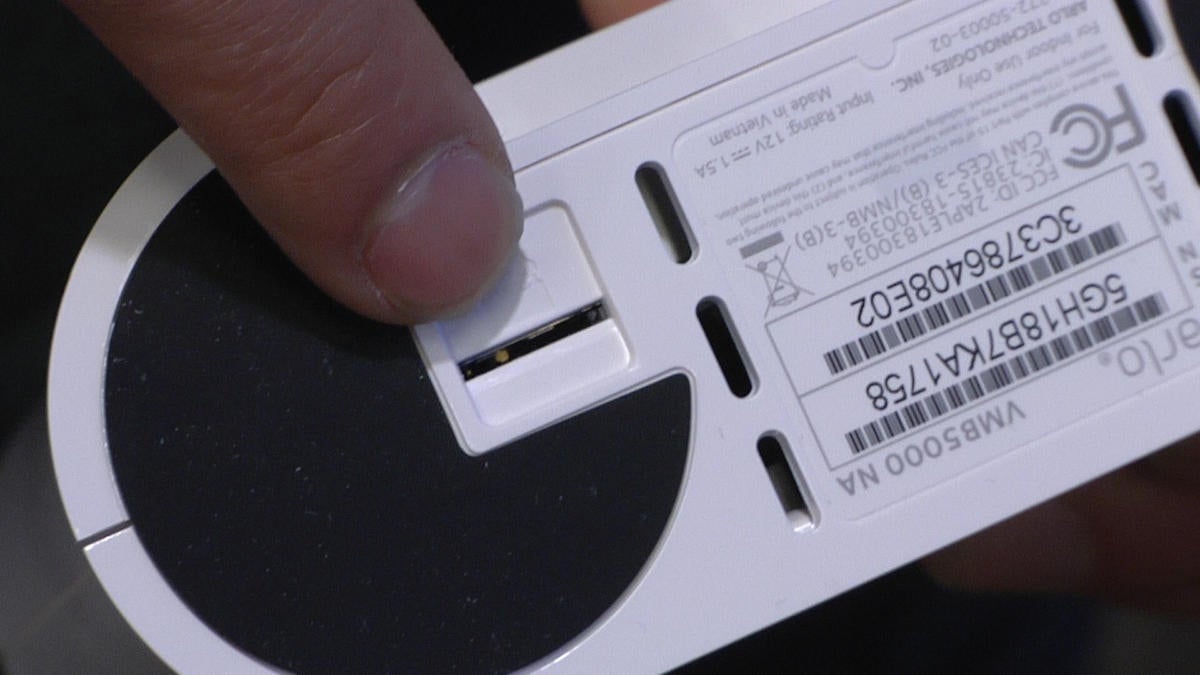
The subscription service adds several attractive features, such as the ability to distinguish between people, animals or other motion, so you might want to subscribe anyway. But if you don’t, the Ultra 4K stood to be a lot less useful. You’d be able to livestream from the camera and record clips to an SD card in the base unit, but accessing those recordings could be done only by physically removing the card from the base unit and popping it into a computer or other device with an SD card reader.
Martyn Williams/IDG
The SD card slot on the bottom of the Arlo base station.
On Thursday, Arlo said it’s working to add the ability to remotely access those recordings.
Arlo senior vice president Pat Collins said the company expects this functionality to to be available in the next six to nine months. Arlo is offering Ultra 4K buyers one-year free free trials of its premium subscription service, so that should cover storage until the remote SD card access is rolled out.
It’s also good news for consumers with slow or metered internet connections, as the video being recorded will initially stay on the local network, and it’s good for those who want to avoid having sensitive surveillance footage from their home stored in the cloud, outside of their immediate control.
Martyn Williams/IDG
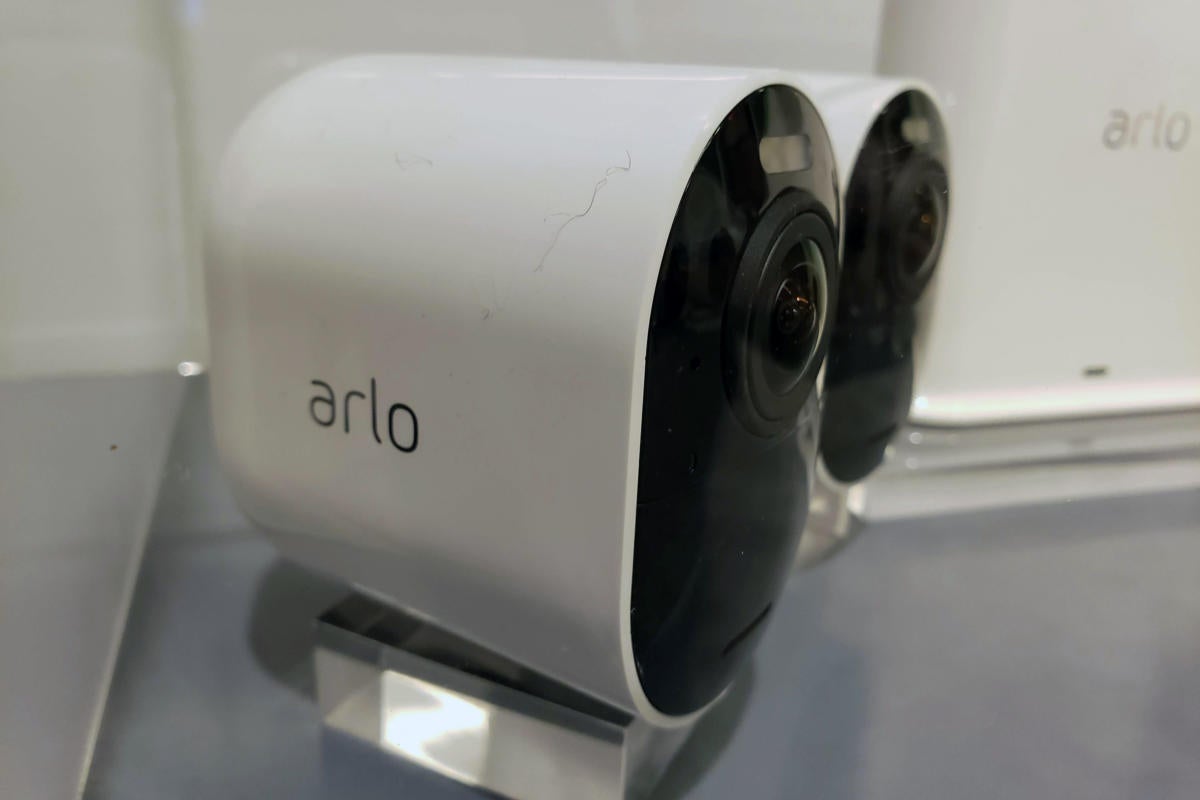
Arlo Ultra 4K cameras on show at CES
The Arlo Ultra 4K is the first 4K security camera from a major smart home vendor and costs $400 bundled with a base station. Packs of between two and six cameras and a base station cost from $600 to $1,700; add-on cameras are priced at $300 each.
4K video stands to offer significantly better resolution than existing high-definition cameras, enabling users to potentially capture more detail of incidents that happen around their home.
TechHive will have a full review once we’ve gotten our hands on the new camera.
To comment on this article and other TechHive content, visit our Facebook page or our Twitter feed.
The true story of Ruth Bader Ginsburg, her struggles for equal rights, and the early cases of a historic career that lead to her nomination and confirmation as U.S. Supreme Court Associate Justice.
Laurel and Hardy, the world’s most famous comedy duo, attempt to reignite their film careers as they embark on what becomes their swan song – a grueling theatre tour of post-war Britain.
Director:
Jon S. Baird
Stars:
John C. Reilly,
Steve Coogan,
Shirley Henderson
The story of Dick Cheney, an unassuming bureaucratic Washington insider, who quietly wielded immense power as Vice President to George W. Bush, reshaping the country and the globe in ways that we still feel today.
On the run in the year of 1987, Bumblebee finds refuge in a junkyard in a small Californian beach town. Charlie, on the cusp of turning 18 and trying to find her place in the world, discovers Bumblebee, battle-scarred and broken.
Director:
Travis Knight
Stars:
Hailee Steinfeld,
Jorge Lendeborg Jr.,
John Cena
Philip is a disabled white billionaire, who feels that life is not worth living. To help him in his day to day routine, he hires Del, an African American parolee, trying to reconnect with his estranged wife. What begins as a professional relationship develops into a friendship as Del shows his grouchy charge that life is worth living. Written by Tom Daly
Join Adam Patrick Murray, Dan Masaoka on Player Ready, Haveaheartsavealife’s weekly PC gaming stream! This week we are diving head first into the Resident Evil 2 remake (which earned high praise in our review from Hayden Dingman) while trying as hard as we can not to scream. Playing on a Maingear F131 equipped with an Intel Core i9 7980xe and dual Nvidia GTX 1080 Ti’s!
Follow Haveaheartsavealife’s Twitch channel (or YouTube) so you don’t miss out on this or future live streams. Tune in every week for podcasts such as The Full Nerd as well as new and old games alike!
To comment on this article and other Haveaheartsavealife content, visit our Facebook page or our Twitter feed.
Three girls are kidnapped by a man with a diagnosed 23 distinct personalities. They must try to escape before the apparent emergence of a frightful new 24th.
Director:
M. Night Shyamalan
Stars:
James McAvoy,
Anya Taylor-Joy,
Haley Lu Richardson
The story of Dick Cheney, an unassuming bureaucratic Washington insider, who quietly wielded immense power as Vice President to George W. Bush, reshaping the country and the globe in ways that we still feel today.
On the run in the year of 1987, Bumblebee finds refuge in a junkyard in a small Californian beach town. Charlie, on the cusp of turning 18 and trying to find her place in the world, discovers Bumblebee, battle-scarred and broken.
Director:
Travis Knight
Stars:
Hailee Steinfeld,
Jorge Lendeborg Jr.,
John Cena
It took M. Night Shyamalan nineteen years to make the trilogy, as the release date suggests (which is 2019). Unbreakable (2000) was being developed shortly after the success of The Sixth Sense (1999). Sixteen years later, Split (2016) came out, and shortly after it, this movie was announced. See more »
Goofs
Joseph mentions the “mutilations at the zoo,” that is, the events seen in Split, as taking place “three weeks ago.” Also, several times it is mentioned that the crash of Eastrail 177 was nineteen years ago. But at the end of Split a diner patron mentions Mr. Glass having been put away FIFTEEN years before (which was closer to accurate at the time of release). Since the train wreck and Elijah’s capture were only a few days apart, both timeframes cannot be true. See more »
At E3 2018 we finally got a chance to go hands-on with Anthem and came away underwhelmed. Oh, it played great—the words I used at the time were “smoother than Destiny 2.” But as I noted at the time, Anthem ($60 preorder on Origin) is coming from BioWare, a studio known for story-driven singleplayer experiences, and yet there was no story on display at E3. “Tell me why BioWare is making this game,” I wrote, “because what I played feels like it could’ve been made by a dozen different studios.”
Well this week EA finally pulled back the curtain on Anthem’s story, as it were, giving us a whopping eight hours of hands-on time with the game. A little peek behind the curtain here: That’s a lot. Our usual hands-on previews run about an hour or two, and a particularly long demo might last three hours. Eight is unheard of, and indicates EA’s either very confident in the game or worried the hype isn’t high enough.
And I’m not really sure where I land either. Anthem’s still incredible to play, but even with eight hours BioWare’s legendary story chops didn’t shine through the way I’d hoped.
Run-and-gun
I don’t want to spend this entire preview dissecting how Anthem plays, in part because that was the focus of our E3 demo and in part because we’ll cover it again in next month’s review. It really is smooth though. That’s the most fitting description. After years making incredible games with middling combat, BioWare’s finally found its stride making third-person shooters.
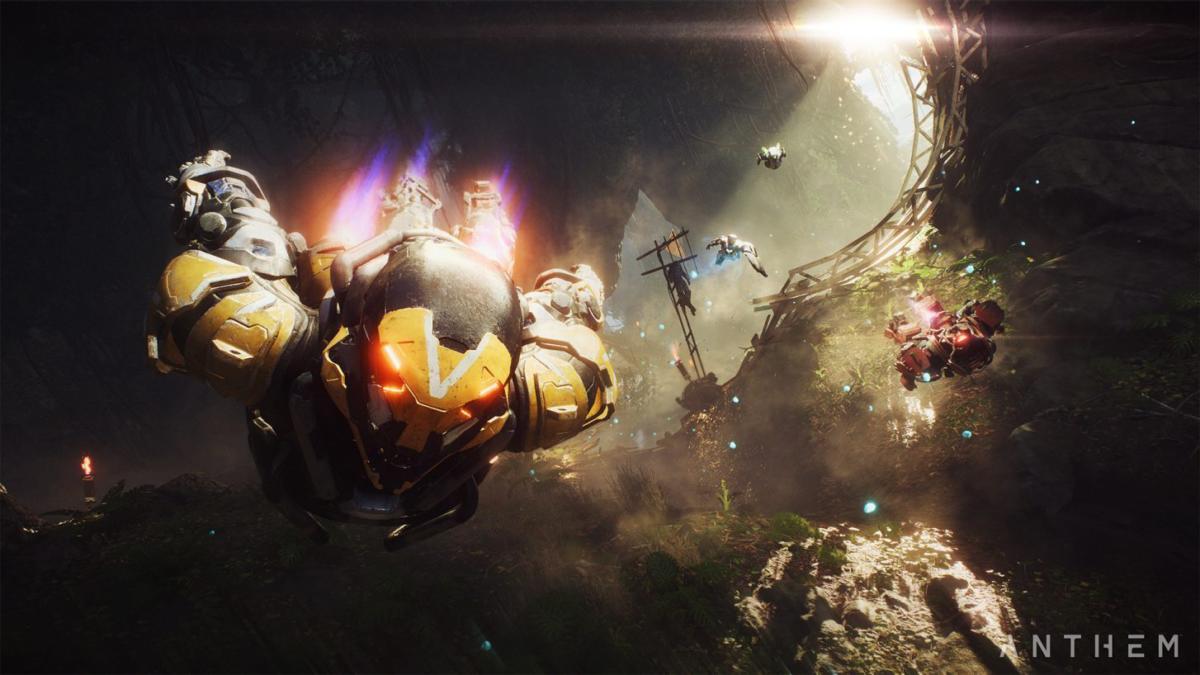
Dodge. Double-jump. Triple-jump, if you’re using the agile Interceptor class. Transition seamlessly into flying, then from flying into hovering and aiming your gun, then back into flying, then to swimming, then back to flying. No other game gives you this many mobility options except, well, Warframe. It’s why that particular comparison feels so fitting at times.
And it’s Anthem’s highlight, to be honest. We didn’t see much of the map even with eight hours to explore, focusing on missions instead, but by far the best part was simply moving place to place. That’s saying something, as typically traversal is my least favorite part of an open-world game. In Anthem, I’d rather spend time doing aerial acrobatics than practically anything else.
Not that the rest is bad. The shooting didn’t impress me nearly as much as the simple joys of moving my character, but it’s solid. The “Heavy Pistol” class (equivalent to Destiny 2’s Hand Cannons) are particularly satisfying to land headshots with, taking out many grunt enemies with a single hit. Honorable mentions go to the light machine guns and marksman rifles, with assault rifles, machine pistols, and sniper rifles my least favorite.
Anthem
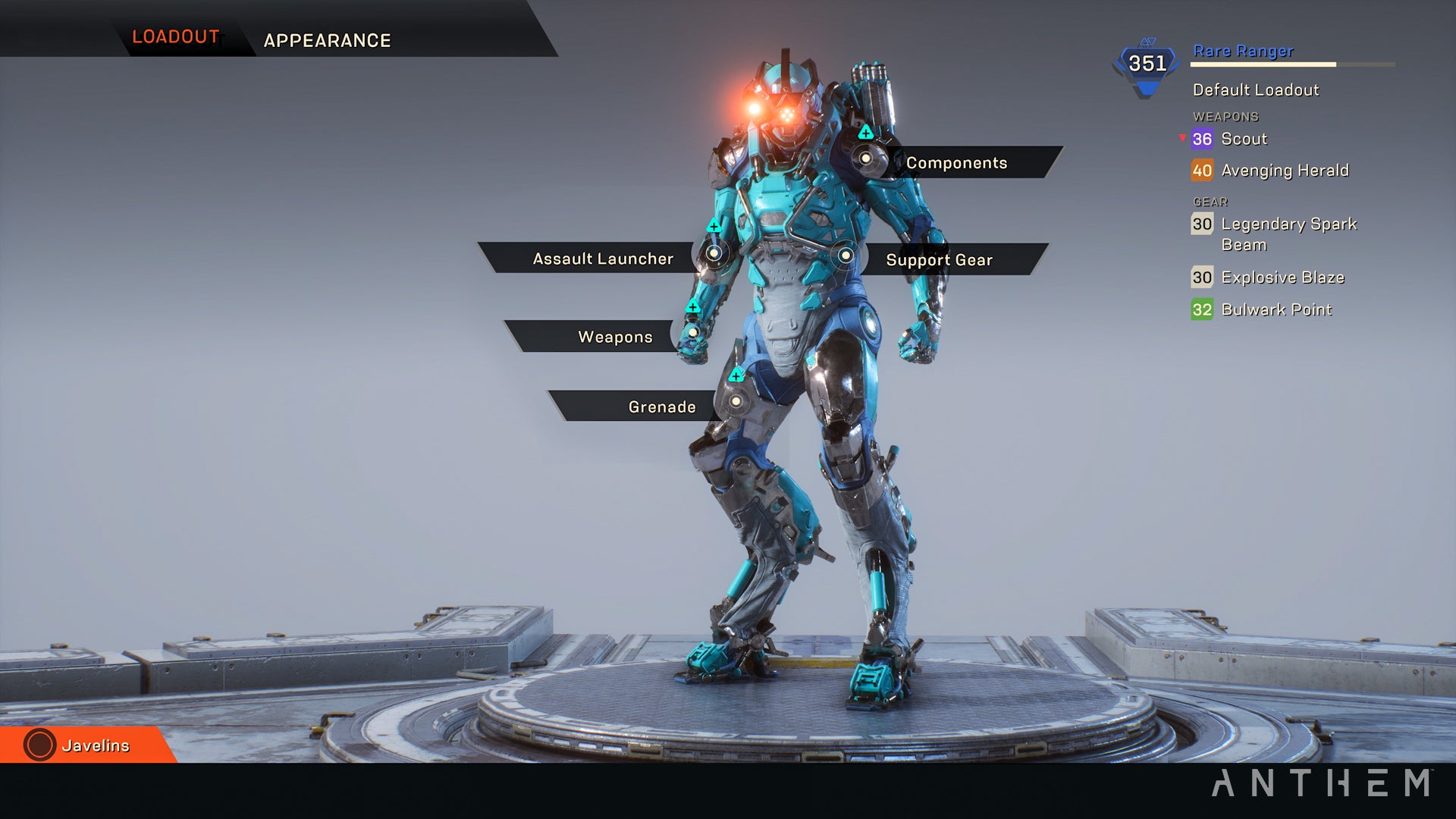
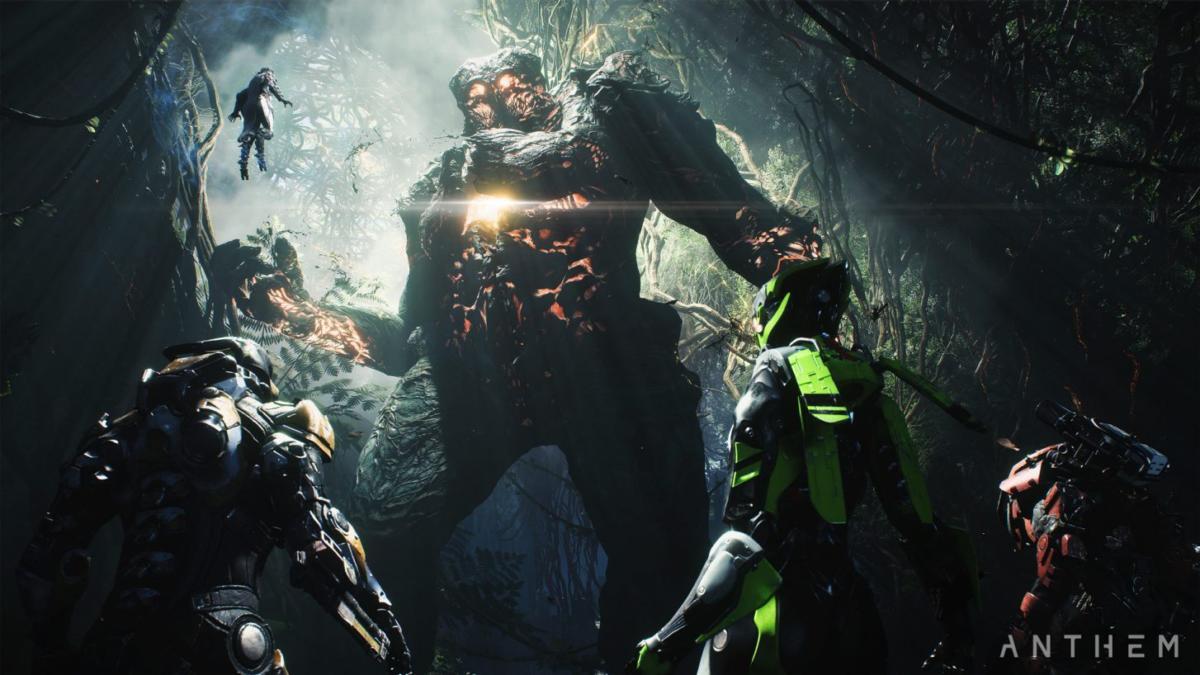
Your secondary abilities are the real draw though. We had the opportunity to experience four of Anthem’s classes, or Javelins, in our demo. Each Javelin is a roughly person-sized mechsuit, though why anyone in the Anthem universe decided to make a mech with a cape I have no idea.
And yes, like in Destiny the class with the cape is the coolest and everyone’s going to want to play it. It’s the “Storm” class, though the name is a bit deceptive. Your skills aren’t just lightning-based but elemental-based in general—fire, lightning, and ice.
Storm Javelins are incredibly overpowered. That might change before release, but literally everyone I talked to at the demo agreed they are game-breaking at the moment. Ice powers allow you to literally freeze entire mobs in place, and you can just keep doing it and doing it. At one point I carried another player through a boss encounter on my own, doing probably 90 percent of the damage and ultimately winning the fight by flying around and peppering it with ice blasts.
Damn it feels great though. The Storm Javelin captures that feeling I love in Destiny 2 where you’re basically an unstoppable demigod. It might get balanced before release but I almost hope it doesn’t. Just make the other classes more useful, BioWare.
They could use it. The Colossus, Ranger, and Interceptor are your standard Tank/DPS/Sniper trio. Of them, the Interceptor is most fun to play because you’re super-fast and have a triple-jump. That said, even the Interceptor doesn’t have options as interesting as the Storm. The Ranger and Colossus meanwhile are simply not for me. Like playing a fighter in an RPG, they’re just boring utility classes.
Anyway, there are some interesting ideas surrounding customization. Whatever Javelin you choose, you unlock armor components that let you swap out your secondary abilities. The Storm starts with a lightning and an ice ability for instance, but there are multiple variations for each slot. It feels a lot more intuitive than Destiny’s leveling system, albeit not as easy to change on the fly.
Even better: You can play all four Javelins from the same character. It’s annoying that Destiny makes you run a different character for each class, so Anthem’s more flexible approach is welcome. Gear is per-Javelin, but it still seems relatively painless to change over.
And cosmetic customization seems like a focal point. No surprise, there. We got a glimpse of Anthem’s shop, and it looks like EA’s going to monetize armor pieces and decals to hell and back. At least you can change out your color scheme for free though, and the base armor looks cool enough as-is. I guess we’ll see how hard it is to unlock new cosmetic items when the game’s properly released, but I don’t really care if it’s all cosmetics. My only complaint is that hitting Escape brings you straight to the store before you can access the map or other important info.
The big bang
That’s all how it plays though, and as I said we talked a lot about that at E3. Point is, it plays great. What I’m still not seeing is the BioWare aspect.
It’s not for lack of trying. We saw a lot of story in our eight-hour demo—multiple cutscenes, a lot of conversations, codex snippets. Anthem definitely doesn’t have the Destiny problem, where all the cool story bits are hidden in places the player will never look.
Anthem
But “more” story doesn’t really mean “better” story, and Anthem’s feels rickety to me so far. You join the game as a Freelancer, a mercenary band of sorts tasked with combating cataclysms, world-threatening events generated by misuse of the Anthem of Creation, a technological artifact of sorts that helped create the world but occasionally malfunctions or…something.
Listen, if that paragraph made you feel tired just know it’s just as exhausting to write it, and to play Anthem. BioWare’s attempting to spin up an entire universe all at once here, and the opening hour of Anthem is the info-dump to end all info-dumps. Characters don’t really talk with you as much as at you, conversations peppered with terms you only half-understand or half-remember. There are five-minute cutscenes full of Important Sounding People doing Important Sounding Things that I literally couldn’t explain if I tried. And if that weren’t enough, your home base is littered with documents to pick up every five or ten feet, more snippets of lore for the dedicated player to read through.
Someone will really love it, I bet, but it feels clumsy and overwrought. There’s no delicacy to Anthem’s story, at least the parts I played, and no real hook. Right out of the gate you watch world-ending events and see multiple team members die, but it’s a world you were introduced to five minutes ago and characters you’ve known for even less time. Anthem doesn’t give you any reason to care.
Anthem
It reminds me of Jupiter Ascending, a comparison that will make sense to all 15 people who saw that film. Like Jupiter Ascending, you can tell too much work has gone into crafting Anthem’s universe, that BioWare’s trying to give Anthem as much depth in a single game as Mass Effect reached with three—and it just doesn’t work.
Again, these are early impressions. Maybe 80 hours will change my mind. I felt surprisingly unengaged though, with not a single character or story beat sticking in my mind after our demo day.
The story “sections” are odd as well. Between missions you wander around your little home base and talk to secondary characters. Unlike the main game though, these sections are in first-person and are a chore to control. The area you need to explore to acquire missions is too large, and your walk speed is irritatingly slow.
And most of the conversations simply don’t matter. They’re certainly not as deep as I’d usually expect from BioWare, though at least there are occasional dialogue options to remind you that yes, this did come from that developer. It’s got one leg up on Fallout 76 in that regard. Options are binary though, and usually break down to “Friendly Reply” or “Asshole Reply,” and it’s hard to tell whether your choices make any real difference. The actual dialogue isn’t so well-written I sought it out either—it’s mostly action-movie quips and such. There was one standout, a story quest that resulted in some…unexpected consequences for a certain scientist. But it was the exception in our demo, not the rule.
Bottom line
I want to believe there are more hilarious, inventive missions waiting. BioWare’s set up some interesting ideas: The Anthem and its relics can literally create something from nothing, which leads to (for instance) missions where you’re suddenly inundated with giant scorpions until you can turn the machine off. There’s a lot that could be done.
But what I played felt generic. I firmly believe Anthem ($60 preorder on Origin) could supplant Destiny if there’s a BioWare-caliber story underpinning its (let me say again: excellent) mechanics. I’ve still seen little-to-no evidence of that though. Playing it feels great, but I’d say the same about Mass Effect: Andromeda and it didn’t stop me from being bored by its repetitive missions and flaky plot.
There’s a VIP demo running this weekend (for people who preorder) and another open-to-everyone demo scheduled for closer to the February 22 release, so if you’re curious about how Anthem plays I recommend jumping into one of those sessions. I think you’ll be impressed by the Javelins at least, the moving and shooting aspects. Maybe that’s enough to win you over, maybe not, but it’s worth a shot.
Otherwise, stay tuned for our review sometime in late February when we can at last digest everything Anthem has to offer.
To comment on this article and other Haveaheartsavealife content, visit our Facebook page or our Twitter feed.
We need backup software for our PCs because storage isn’t foolproof, and won’t last forever. If your data isn’t backed up, when the inevitable accident or failure occurs, it’s gone.
It would be nice if Microsoft itself provided Windows users with something like Apple’s Time Machine: an effective, set-it-and-forget-it, total system recovery and backup solution that requires little interaction or thought on the part of the user.
Instead, the company delivers a mishmash of restore points, recovery discs, file backup, and even the un-retired System Backup (Windows 7), which was probably originally put out to pasture for its propensity to choke on dissimilar hardware. Online backup services are another option, but desktop clients tend to offer far more flexibility.
Plenty of vendors have stepped in with alternatives, and while none are quite as slick or transparent as Time Machine, some come darn close—and many are free. Read on for our top picks.
Editor’s note: Updated January 24, 2019 to include Acronis TrueImage 2019 as our new pick for best overall backup program.
Best overall backup program
Acronis True Image 2019 (available on Amazon) is quite arguably the fastest, most powerful backup solution available to consumers. It offers just about every conceivable backup option: incremental, differential, super-flexible scheduling, pre/post operation commands, email notifications, just to name a few. There’s also a one-way (mirroring) function for syncing a folder to a destination, as well as client apps for your mobile devices to keep those backed up. Whew! It’s also, slowly but surely, working its way toward being truly user-friendly.
Granted, all that functionality requires a fair number of background processes and a heavy footprint on your system. But if you really want the maximum backup protection for your system, there’s really nothing else that comes close to True Image in the consumer arena. Read our full review.
Best budget backup program
Among the free programs we tested, Backupper Standard wins primarily because it has the most features, including imaging, file backup, disk cloning, and plain file syncing, plus multiple scheduling options (see our full review). Sure, its bitmapped interface may be retro, but the layout and workflow are intuitive. And though it’s on the slower side for backing up sets of files, it’s the fastest software we’ve tested so far for backing up full disks and partitions. Its CPU usage during backup is also commendably light.
What to look for in backup software
As with most things—don’t over-buy. Features you don’t need add complexity and may slow down your system. Additionally, if you intend to back up to a newly purchased external hard drive, check out the software that ships with it. Seagate, WD, and others provide backup utilities that are adequate for the average user.
File backup: If you want to back up only your data (operating systems and programs can be reinstalled, though it’s mildly time- and effort-consuming), a program that backs up just the files you select is a major time-saver. Some programs automatically select the appropriate files if you use the Windows library folders (Documents, Photos, Videos, etc.).
Image backup/Imaging: Images are byte-for-byte snapshots of your entire hard drive (normally without the empty sectors) or partition, and can be used to restore both the operating system and data. Imaging is the most convenient to restore in case of a system crash, and also ensures you don’t miss anything important.
Boot media: Should your system crash completely, you need an alternate way to boot and run the recovery software. Any backup program should be able to create a bootable optical disc or USB thumb drive. Some will also create a restore partition on your hard drive, which can be used instead if the hard drive is still operational.
Scheduling: If you’re going to back up effectively, you need to do it on a regular basis. Any backup program worth its salt allows you to schedule backups.
Versioning: If you’re overwriting previous files, that’s not backup, it’s one-way syncing or mirroring. Any backup program you use should allow you to retain several previous backups, or with file backup, previous versions of the file. The better software will retain and cull older backups according to criteria you establish.
Online support: An offsite copy of your data is a hedge against physical disasters such as flood, fire, and power surges. Online storage services are a great way to maintain an offsite copy of your data. Backup to Dropbox and the like is a nice feature to have.
FTP and SMB/AFP: Backing up to other computers or NAS boxes on your network or in remote locations (say, your parent’s house) is another way of physically safeguarding your data with an offsite, or at least physically discrete copy. FTP can be used for offsite, while SMB (Windows and most OS’s) and AFP (Apple) are good for other PCs or NAS on your local network.
Real time: Real-time backup means that files are backed up whenever they change, usually upon creation or save. It’s also called mirroring and is handy for keeping an immediately available copy of rapidly changing data sets. For less volatile data sets, the payoff doesn’t compensate for the drain on system resources. Instead, scheduling should be used.
Continuous backup: In this case, ‘continuous’ simply means backing up on a tight schedule, generally every 5 to 15 minutes, instead of every day or weekly. Use continuous backup for rapidly changing data sets where transfer rates are too slow, or computing power is too precious for real-time backup.
Performance: Most backups proceed in the background or during dead time, so performance isn’t a huge issue in the consumer space. However, if you’re backing up multiple machines or to multiple destinations, or dealing with very large data sets, speed is a consideration.
How we test
We run each program through the various types of backups it’s capable of. This is largely to test reliability and hardware compatibility, but we time two: an approximately 115GB system image (two partitions), and a roughly 50GB image created from a set of smaller files and folders. We then mount the images and test their integrity via the program’s restore functions. We also test the USB boot drives created by the programs.
All of our reviews
If you’d like to learn more about our top picks as well as other options, you can find links below to all of our backup software reviews. We’ll keep evaluating new programs and re-evaluating existing software on a regular basis, so be sure to check back for our current impressions.


 Martyn Williams/IDG
 Martyn Williams/IDG



 Anthem
 Anthem
 Anthem
 Anthem
 Rayden Reviews